
Dice Hoarder Wiki: All Systems, Sets and 60 Dice Slots
A complete Dice Hoarder wiki: release facts, the 60-slot shelf system, seven-piece sets, eight skills, 16 achievements and the floppy-disk story.
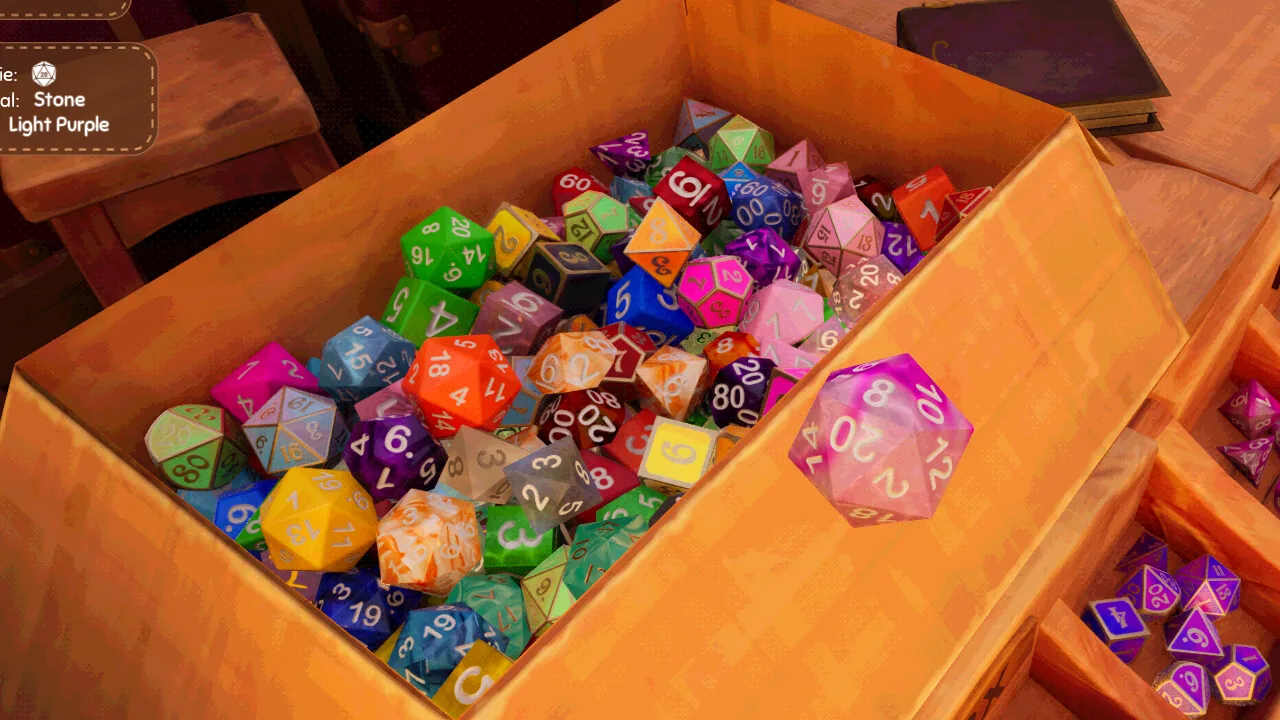
Dice Hoarder is a first-person cozy organizing game from DieCorp Games, released on Steam for Windows on 13 November 2026 at $5.99, with a 10% launch discount bringing it to $5.39. You are hired to stock a mysterious dice shop: sort thousands of dice by material and colour, rebuild seven-piece sets, meet each day's shop-value target and install floppy disks that grant new powers.
This page is the index for everything else on the site: the 60-slot wall, the set rule, skills, collectibles and the story. Each section links to the dedicated guide instead of repeating it.
What are the key facts about Dice Hoarder?
| Fact | Detail |
|---|---|
| Developer / publisher | DieCorp Games |
| Release date | 13 November 2026 |
| Platform | Windows PC |
| Price | $5.99, 10% launch discount to $5.39 |
| Genre | Casual, indie, first-person cozy organizing |
| Steam app ID | 3687090 |
| Modes | Story Mode and Chill Mode (also called Zen Mode) |
| Display slots | 60 across seven shelf groups |
| Dice in a full shop | 420 (60 sets × 7 dice) |
| Achievements | 16 |
| Controller | Partial support, Xbox-style layout |
The game launched with roughly 200,000 wishlists and a small concurrent player count, which matches its budget price and short, focused structure.
Sorting, sets, skills, disks, story and achievements all feed each other. The sections below link to the dedicated guide for each so this page stays an index.
What is the core loop?
Every shift follows the same pattern:
- Unpack new dice from boxes.
- Inspect each die to read its material and colour.
- Place it in the matching display slot.
- Complete seven-piece sets to raise the shop's value.
- Hit the day's required value, then close the day at the computer.
There are no timers. The value gate is the only thing that ends a day, so the game is as relaxed or as efficient as you make it. The how-to-play guide → walks through the first hour.
How is the shop organised?
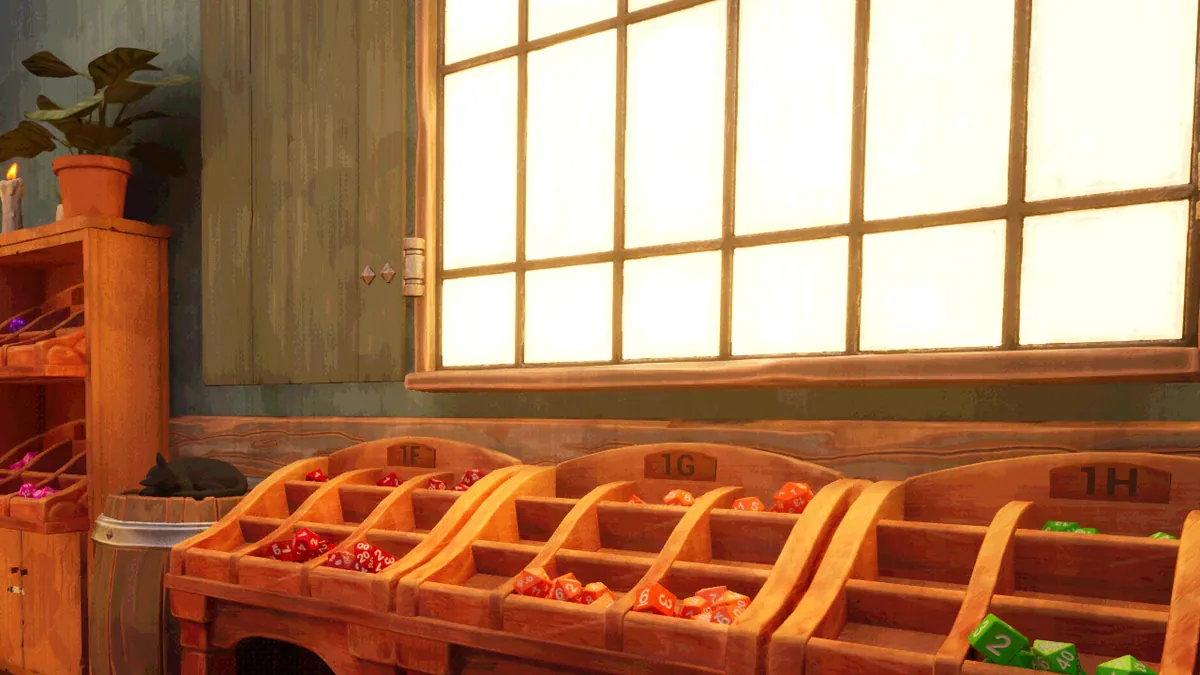
The wall is divided into seven shelf groups, labelled A to G, and each slot has a number. The grouping is by material:
- A — plastic, 10 slots
- B — solid resin, 8 slots
- C — clear resin, 12 slots
- D — metal, 10 slots
- E — gemstone, 10 slots
- F — special, 6 slots
- G — solid resin, 4 slots
Sixty slots in total. The full breakdown, including every colourway and its code, is in the 60-slot shop map → and the dice list →.
What are seven-piece sets?
Each slot holds one complete set: percentile, D4, D6, D8, D10, D12 and D20, all in the same material and colourway. A slot with six dice is incomplete and does not count as a finished set. The set rule drives the achievements, the value gate and the sorting order, and it is explained in full in the seven-piece set guide →.
What skills and powers exist?
There are eight skills in the game, upgraded with points earned through play. The confirmed ones include:
- Find Missing Dice — tracks the remaining dice of a set.
- Pull die into hand — a magic power that retrieves a die directly.
- Nimble Step — crouching, used to reach low shelves and hidden items.
- True Sight — referenced by the community as a detection aid.
The remaining four are learned through normal progression. A max-level save can unlock Multiclass Madness (learn all eight) and Archmage (fully upgrade every skill, currently 0.1% of players). The skill guide → ranks them by usefulness.
What are floppy disks?
Floppy disks appear in the shop over the first days and grant powers when installed at the computer. They are also the story's central mystery: you do not know who leaves them. Two labels are clearly readable in the launch trailer, TRUE STORY and HELP US, but the game does not publish a disk count or a location list. The floppy disk guide → separates what is confirmed from what is still speculation.
What is the story about?
You are hired to run a dice shop by someone you never meet. Disks appear anonymously, the basement is locked, and the shop itself is not quite normal. The story is delivered through messages on the computer and through the disks rather than cutscenes. It is not a horror game, despite the occasional eerie beat.
The basement guide → covers the locked door, and the endings guide → explains what the launch build does and does not resolve.
Which mode should you play?
- Story Mode is shift-based and gates the next day behind the value target. It contains the mystery, the disks and the basement thread.
- Chill Mode (called Zen Mode in the launch announcement) removes the story and lets you restock without narrative pressure.
Both modes use the same sorting rules. If you want to learn the shelf layout before committing to the story, start in Chill Mode.
What is there to complete?
Sixteen achievements, 60 display sets, 14 hidden edible dice, eight skills and a handful of story beats. The rarest achievement at launch is Archmage at 0.1%, followed by No Magic, No Problem at 1.2% — the latter asks you to sort everything without spell skills, which is a genuine challenge run rather than a formality.
FAQ
Is Dice Hoarder a horror game? No. It is a cozy organizing game with a mystery thread. Some story beats are eerie, but there is no combat or chase sequence.
How long is Dice Hoarder? There is no published completion time and no timer in-game. The story is short and the sorting is open-ended; most of the long-tail play comes from completing all 60 sets and the achievement list.
Does Dice Hoarder have multiplayer or co-op? No. Steam lists single-player only and family sharing, with no co-op or multiplayer categories.
Is there a Switch version? No. The game launched on Windows PC only. The developer's wishlist FAQ says consoles and Mac would be explored after launch, not before.
Official source: Dice Hoarder on Steam ↗, Steam achievements ↗, launch times, price and features ↗