
Dice Hoarder Guide: How to Play in Your First Hour
A complete Dice Hoarder guide: controls, the daily value gate, seven-piece sets, display letters and the first upgrades that speed up every shift.
Dice Hoarder is a first-person sorting game, not a shop simulator with customers and timers. You pick up dice, read their material and colour, and place each one in the matching slot of a 60-slot display wall. The first hour is about learning one rule: material first, colour second. Get that order right and the shop's daily value target stops being a puzzle.
This Dice Hoarder guide covers the controls you actually need, the loop that ends each day, how the A–G display groups work, and the mistakes that make new players waste a full shift.
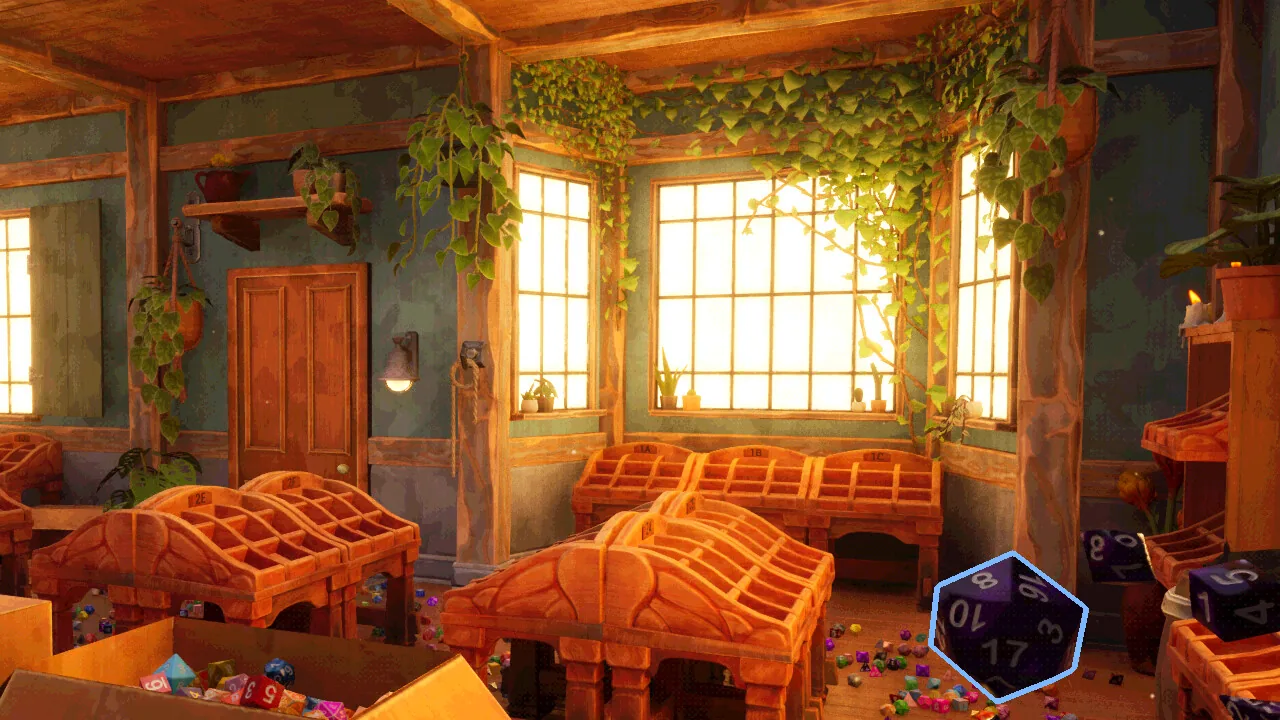
What are the controls in Dice Hoarder?
The game is built for mouse and keyboard. You move in first person, pick up a die, and hold it up to inspect it. While a die is in your hand, the left panel of the screen shows its material and colour — that panel is the most important UI element in the game, because the shelf letters are organised by material, not by colour.
Four actions carry every shift:
- Pick up and inspect a die to read its material and colour.
- Place it in a slot. The slot accepts one die; a wrong placement is not fatal, but it does break the set inside that slot.
- Zoom to look at a distant shelf or a die on the floor.
- Crouch once you unlock it, to reach low shelves and dice that rolled under furniture.
There is no sprint meter, no stamina bar and no clock counting down. The pressure in Dice Hoarder is the day's required value, not a timer.
Since the Day 1 hotfix, a display letter glows red and plays a sound when a die is in the wrong slot. Use that feedback instead of guessing. The same patch added an Auto-add to inventory toggle and a map keybind toggle in the options.
What is the core loop in Dice Hoarder?
Each day has four beats:
- Sort the delivery. New dice arrive in boxes and on the floor. Pick them up, inspect them, and route them to the correct shelf group.
- Complete seven-piece sets. Every display slot holds one complete set: percentile, D4, D6, D8, D10, D12 and D20, all in the same material and colour.
- Hit the required value. The HUD tracks the shop's stocked value. The next day does not begin until you reach the target shown on screen.
- Use the computer. At the end of a shift you can install a floppy disk, spend skill points, read messages and trigger the next day.
The store page describes the loop as rebuilding "400+ seven-piece dice sets". A fully stocked shop is 60 slots × 7 dice = 420 dice, which is where that 400+ number comes from.
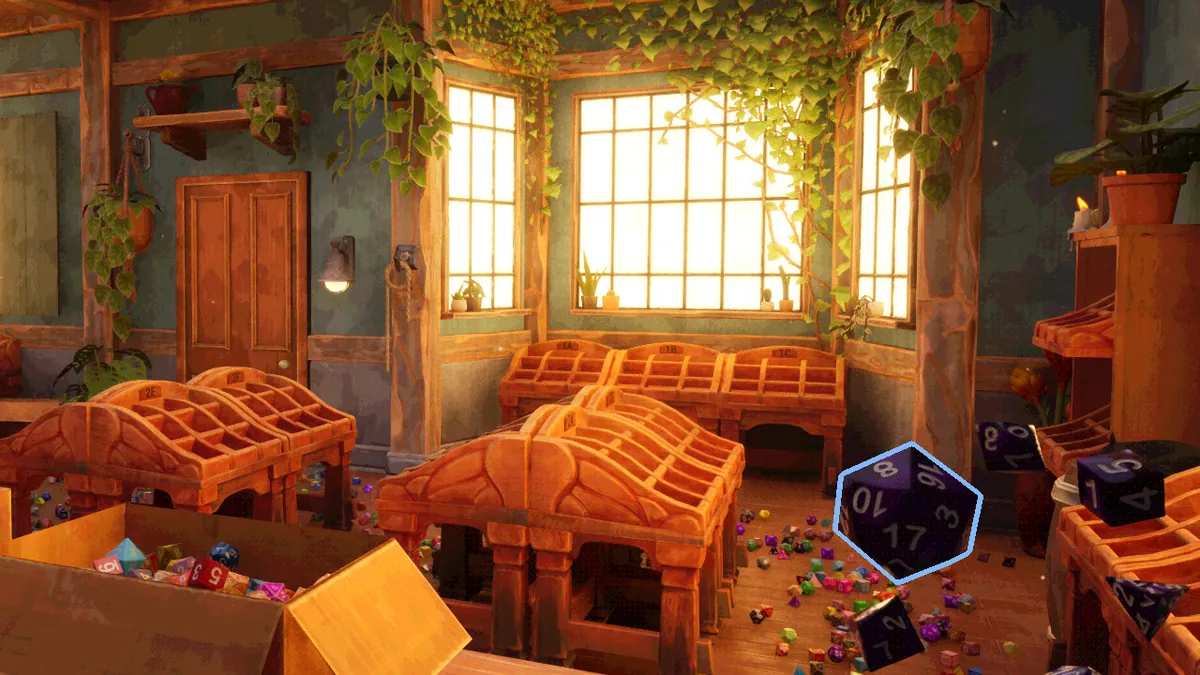
Why do the display letters matter?
The seven shelf groups are labelled A through G on the front of the displays, and each slot inside a group has a number. The letters are not decoration: they encode the material.
| Group | Material | Slots |
|---|---|---|
| A | Plastic | A1–A10 |
| B | Solid resin | B1–B8 |
| C | Clear resin | C1–C12 |
| D | Metal | D1–D10 |
| E | Gemstone | E1–E10 |
| F | Special | F1–F6 |
| G | Solid resin (second run) | G1–G4 |
That is 60 slots. Learn the material order once and you will stop carrying dice across the shop, inspecting them, and carrying them back. The full slot-by-slot breakdown lives in the 60-slot shop map →.
Two dice can look identical from arm's length and belong to different groups: a glossy pink B8 and a pink G2 are both solid resin, but a pink C2 is clear resin and a pink D9 is metal. The left panel removes the guesswork; the shelf letter confirms it.
How do you finish a day without wasting time?
Three habits do most of the work:
- Empty the boxes before you shelve. Pull dice out in handfuls, inspect them on the counter, and build a mental queue of A, B, C, D, E, F and G. One trip per group beats seven trips per die.
- Finish sets, not slots. A slot with six of seven dice contributes far less than a completed set. If a colourway is missing one die, leave a note in your head and hunt that die before you start a new colour.
- Keep the floor clear. Dice on the floor still count as unsorted stock, and they are easy to lose under shelves. The Day 1 hotfix specifically addressed dice that vanished or moved to wrong slots, so if a die refuses to appear, reload before you tear the shop apart.
The value gate is the only thing that ends a day. You can keep sorting after you hit the target, and you should: the extra stock carries into the next shift.
What should you do with the first floppy disk?
Floppy disks start appearing in the shop over the first few days. They are not collectibles to hoard — take them to the computer and install them. The first powers are practical: one helps you track down the missing dice of a set, and one lets you pull a die directly into your hand.
Do not expect a tutorial pop-up to explain every disk. Read the label, install it, then test the new ability on a set you are already building. The floppy disk guide → tracks the confirmed labels and what each power does.
What should a new player upgrade first?
Spend the first skill point on anything that reduces handling time, not on cosmetics. Find Missing Dice is the highest-value early pick because it turns the worst part of the loop — hunting one missing D8 across a 60-slot wall — into a direct route. Movement and reach upgrades come second; they matter more once the upper shelves are full.
The skill ranking → explains the full eight-skill tree, and the display upgrade order → covers which furniture to buy first.
FAQ
Is Dice Hoarder a timed game? No. There are no timers on sorting or on the day. The next day begins only when you have stocked the required value of dice, so you can take as long as you like.
Can I play without the story? Yes. Chill Mode removes the story and lets you restock without the mystery thread. The launch announcement also calls this Zen Mode; both names refer to the no-story mode.
What is the difference between Story Mode and Chill Mode? Story Mode is shift-based and gates progression behind the daily value target. Chill Mode keeps the sorting but drops the story structure.
Do I need to complete every set to finish a day? No. The day ends when the shop value target is met. Completed sets are the most efficient way to raise that value, but you are not required to fill all 60 slots first.
Official source: Dice Hoarder on Steam ↗, Day 1 Hotfix Patch ↗, launch times and features ↗